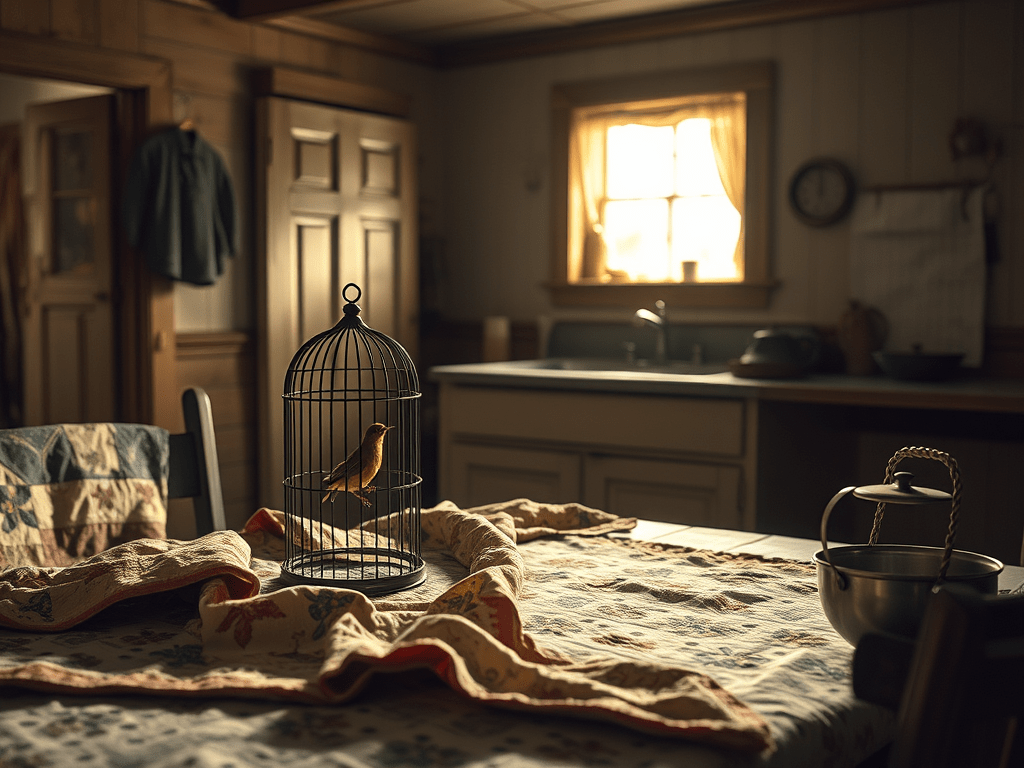
Susan Glaspell’s one-act play, Trifles, first performed in 1916, is a seminal work in American theater that delves into themes of gender roles, isolation, and the nature of justice. Drawing from a real-life case that Glaspell covered as a journalist, the play offers a critical look at the lives of women in the early 20th century and challenges the societal norms that confined them.
Plot Overview
Trifles is set in the rural farmhouse of John and Minnie Wright. The play opens with the investigation into John Wright’s murder, with the primary suspects being his wife, Minnie. As the male authorities—Sheriff Peters, County Attorney Henderson, and neighbor Mr. Hale—search for evidence, they dismiss the kitchen and its contents as insignificant “trifles.” Meanwhile, Mrs. Peters and Mrs. Hale, accompanying their husbands, discover subtle clues in the domestic space that reveal Minnie’s unhappy life, leading them to understand her possible motive.
Themes
Gender Roles and Feminism
The play highlights the patriarchal attitudes of the time, showcasing how men’s dismissal of women’s roles and insights leads them to overlook crucial evidence. The men consider the women’s domain—the kitchen and its contents—as irrelevant to the investigation, underscoring the societal belief that women’s concerns are mere “trifles.” This perspective is evident when the men mock the women for worrying about Minnie’s unfinished quilting:
SHERIFF: They wonder if she was going to quilt it or just knot it!
This condescension blinds the men to the reality of Minnie’s life, while the women, through their shared experiences and empathy, uncover the motive behind the crime. This dynamic illustrates the early feminist message of the play, emphasizing the value of women’s perspectives and the consequences of their marginalization.
Isolation and Loneliness
Minnie Wright’s isolation is a central theme in Trifles. Living in a remote farmhouse with a detached husband, Minnie’s loneliness is palpable. Mrs. Hale reflects on this, saying:
MRS. HALE: I know how things can be—for women. We live close together and we live far apart. We all go through the same things—it’s all just a different kind of the same thing.
This statement underscores the shared but often unspoken struggles of women, highlighting how societal expectations can lead to profound isolation.
Justice and Morality
The play raises questions about the nature of justice. The legal system, represented by the male authorities, seeks concrete evidence to prosecute Minnie. In contrast, Mrs. Peters and Mrs. Hale grapple with a moral dilemma upon discovering the dead canary—a symbol of Minnie’s lost happiness and the catalyst for her actions. Their decision to hide the evidence reflects a form of justice rooted in empathy and an understanding of Minnie’s suffering, challenging the black-and-white nature of legal justice.
Symbols
The Dead Canary
The canary represents Minnie’s lost youth and joy. Once a lively woman who sang in the choir, Minnie’s life became oppressive after marriage. The discovery of the strangled canary, hidden in a sewing box, mirrors Minnie’s own life—silenced and confined. Mrs. Hale draws a parallel between the bird and Minnie:
MRS. HALE: She—come to think of it, she was kind of like a bird herself—real sweet and pretty, but kind of timid and—fluttery. How—she—did—change. Tell you what, Mrs. Peters, why don’t you take the quilt in with you? It might take up her mind.
The canary’s death symbolizes the culmination of Minnie’s emotional abuse, leading to her breaking point.
The Quilt
The quilt signifies Minnie’s life and mental state. The erratic stitching found by Mrs. Hale and Mrs. Peters indicates her disturbed mind, reflecting her turmoil and the unraveling of her sanity. The method of John Wright’s murder—strangulation—parallels the act of “knotting” the quilt, subtly linking Minnie’s domestic life to the crime.
Critical Reception and Legacy
Upon its release, Trifles was praised for its realistic portrayal of rural life and its subtle critique of gender inequalities. Over time, it has been recognized as a pioneering feminist work that challenges traditional gender roles and highlights the importance of women’s experiences. Glaspell’s nuanced writing has cemented Trifles as a staple in American theater, prompting discussions about the intersections of gender, justice, and societal expectations.
Conclusion
Susan Glaspell’s Trifles masterfully weaves themes of gender disparity, isolation, and the subjective nature of justice into a compelling narrative. Through its rich symbolism and character dynamics, the play not only critiques the societal norms of its time but also resonates with contemporary audiences, reminding us of the enduring struggles for empathy and equality.
Works Cited
Glaspell, Susan. Trifles. 1916.
Ben-Zvi, Linda. “Murder, She Wrote: The Genesis of Susan Glaspell’s Trifles.” Theatre Journal, vol. 44, no. 2, 1992, pp. 141–162.
Holstein, Suzy Clarkson. “Silent Justice in a Different Key: Glaspell’s ‘Trifles’.” The Midwest Quarterly, vol. 44, no. 3, 2003, pp. 282–290.
Hedges, Elaine. “Small Things Reconsidered: Susan Glaspell’s ‘Trifles’.” Women’s Studies, vol. 12, no. 1, 1985, pp. 89–110.
Mael, Phyllis. “Trifles: The Path to Sisterhood.” Literature and Psychology, vol. 35, no. 1-2, 1989, pp. 282–288.
*Note: The quotations from the play are sourced from Susan Glaspell’s “Trif

 Education Universe