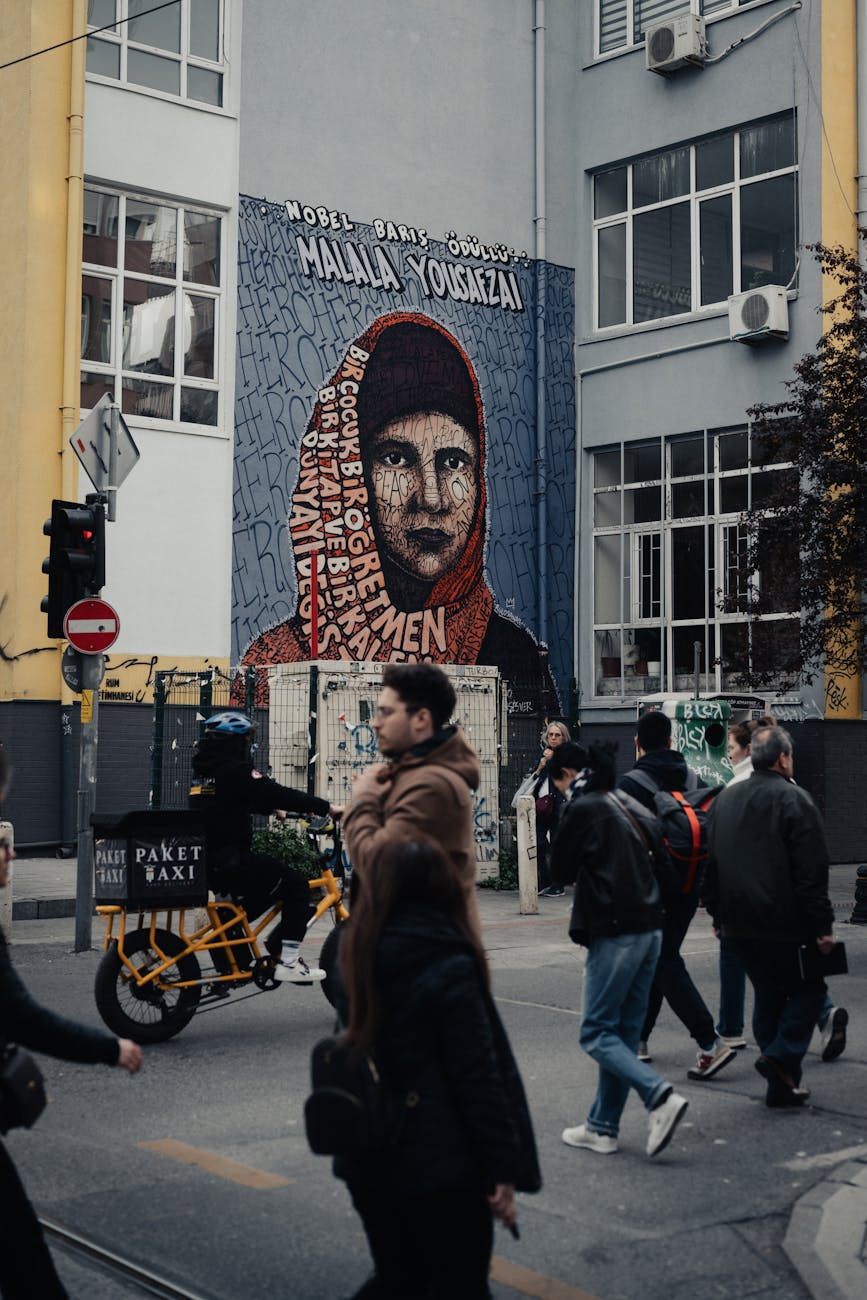
Malala Yousafzai is a powerful voice in the fight for education and justice. Her rhetorical strategies change depending on her audience and purpose. In her Nobel Peace Prize Lecture, she uses distinct rhetorical moves for that audience. In her children’s book Malala’s Magic Pencil, she uses different rhetorical techniques to reach young readers. By shifting her language and tone, Malala adapts her message without losing her core values.
We need to look closely at the specific rhetorical strategies she uses in each text. This helps us understand how her language works. We should examine how she frames her story and builds trust. Additionally, consider how she uses emotional appeal and points toward action. These aren’t random stylistic choices; they’re deliberate tools to shape how her audience thinks, feels, and responds.
CLAIM: Framing Personal Story as a Universal Call — Narrative as Rhetorical Strategy
In both texts, Malala uses narrative as a rhetorical move—but she frames the story differently depending on her audience. In Malala’s Magic Pencil, she uses a personal narrative. It is imaginative. She gently guides young readers into serious topics like inequality. She also addresses violence. In the Nobel Lecture, she uses a testimony-style narrative to assert her authority and build urgency around global education.
EVIDENCE: Paired Quotes
From Malala’s Magic Pencil:
“Every night before I went to bed, I wished for a magic pencil. I would use it to put a lock on my door so my brothers couldn’t bother me.”
From the Nobel Lecture:
“I had two options; one was to remain silent and wait to be killed. The second was to speak up and then be killed.”
ANALYSIS: Shifting the Emotional Temperature
In Malala’s Magic Pencil, Malala opens with a light, relatable image of childhood—using a pencil for playful, everyday wishes. This language builds trust with young readers. She’s not just a girl from Pakistan; she’s a kid like them. She eases into bigger ideas by first grounding the story in innocent imagination.
This rhetorical move softens the entry point for young readers. It lowers the emotional temperature and makes the topic of injustice feel approachable, not overwhelming. That’s key in children’s literature—the goal is to plant ideas, not trigger distress.
In contrast, the quote from the Nobel Lecture throws the reader directly into a life-or-death choice. There’s no softening, no playfulness. The stakes are made brutally clear, and the emotion is intense. This is deliberate. Malala’s audience in Oslo isn’t children—it’s world leaders, policymakers, and adults with power. The rhetorical effect here is not to comfort but to confront. Her sharp language forces the listener to feel the urgency of the situation.
By framing her story differently, Malala activates different emotional responses: empathy in one, moral responsibility in the other.
CONNECTION: Audience, Genre, and Purpose
The contrasting tone and rhetorical moves are closely tied to the genre and audience of each work. Malala’s Magic Pencil is a children’s picture book. Its purpose is educational but gentle: introduce children to activism through metaphor and story. The magic pencil becomes a symbol of hope, imagination, and eventually action. The audience is young, possibly reading with a parent or teacher. That context demands warmth and accessibility.
The Nobel Lecture, on the other hand, is formal, public, and political. The purpose is direct persuasion—convincing world leaders to take action on education and human rights. The audience expects credibility, seriousness, and a call to action. So Malala shifts gears. She speaks not as a storyteller, but as a survivor and advocate. Her words are chosen to leave no room for passivity.
In both cases, she’s telling her story—but how she tells it is shaped by who’s listening.
CLAIM: Repetition as Emphasis — Strategic Reinforcement of Core Values
Another rhetorical move Malala uses in both texts is repetition, but again, the effect is tailored to context. In Malala’s Magic Pencil, repetition creates rhythm and emphasis, suited for a read-aloud experience. In the Nobel Lecture, repetition is used to drive home the urgency and scale of the problem.
EVIDENCE: Paired Quotes
From Malala’s Magic Pencil:
“I would erase the smell of garbage from my city. I would erase war, poverty, hunger.”
From the Nobel Lecture:
“One child, one teacher, one book and one pen can change the world.”
ANALYSIS: Rhythm with a Purpose
In the picture book, Malala uses repetition with a poetic touch. “I would erase…” becomes a mantra of hope. Each repetition expands the reach of her imagination. First, it’s about her city. Then it’s the world. The effect is uplifting—it suggests that even a small dream can grow into something bigger. For children, this pattern is easy to follow, and it keeps them engaged.
In the Nobel speech, repetition functions as a rallying cry. “One child, one teacher, one book, one pen…” It’s not just rhythmic—it’s memorable. Each part builds on the last to emphasize simplicity and possibility. The effect is assertive and empowering. Malala is reducing a massive global issue—education inequality—down to its most basic, human components. And she’s calling the audience to believe in the power of those components.
Repetition here is more than a literary device. It’s a strategic way to make her message stick—and to move people from agreement to action.
CONNECTION: Function of Form
Genre matters. In Malala’s Magic Pencil, the repetition feels like a dream sequence—an invitation to imagine. That fits the genre of children’s literature, where message and magic often go hand-in-hand. In the Nobel Lecture, the repetition works more like a slogan. It’s meant to be quoted, remembered, and repeated—ideal for a speech with global reach.
Both use the same rhetorical move, but with different rhythms and emotional effects. In the book, it’s quiet hope. In the speech, it’s determined belief.
CLAIM: Use of Contrast — Highlighting Injustice Through Juxtaposition
Malala also relies heavily on contrast—placing opposing ideas side by side to expose injustice. This move is present in both texts but again operates at different levels.
EVIDENCE: Paired Quotes
From Malala’s Magic Pencil:
“But my wishes changed. I wished for peace. I wished for war to end.”
From the Nobel Lecture:
“Why is it that countries which we call strong are so powerful in creating wars but so weak in bringing peace?”
ANALYSIS: From Personal Shift to Global Challenge
In the children’s book, the contrast is internal. Malala shows how her own wishes changed over time—from playful to profound. This transition reflects emotional maturity and introduces the idea that even children can grow to care about justice. The contrast is gentle—it teaches reflection.
In the lecture, contrast is used to challenge hypocrisy. She calls out global powers for their misplaced priorities. The rhetorical effect is sharper, more confrontational. She’s not reflecting here; she’s holding systems accountable.
Again, both use contrast, but one turns inward to inspire change, while the other looks outward to demand it.
CONCLUSION: Language with Purpose
Malala Yousafzai’s rhetoric is powerful for many reasons. It is not just the story she tells. It is how she adapts her language to fit her audience, genre, and purpose. In Malala’s Magic Pencil, she uses imagination, repetition, and gentle contrast to spark awareness in young readers. In her Nobel Peace Prize Lecture, she uses personal testimony. She employs urgent repetition and bold contrast. These techniques push for action on a global scale.
At the heart of both is the same message: education matters, and everyone has a role to play. But the way that message is delivered changes depending on who needs to hear it. That’s what makes her rhetoric not just moving—but effective.
Related Article: More Than Words: How Malala Yousafzai Uses Constitutive Rhetoric to Shape Global Identity
Works Cited
Yousafzai, Malala. Malala’s Magic Pencil. Illustrated by Kerascoët, Little, Brown and Company, 2017. https://youtu.be/HMsmlxmOK18?si=zhdzrkw0j1x8K5o9
Yousafzai, Malala. “Nobel Peace Prize Lecture.” NobelPrize.org, 10 Dec. 2014, https://www.nobelprize.org/prizes/peace/2014/yousafzai/lecture/.

 Education Universe