College Hybrid Courses

Perhaps you are curious about what a hybrid course is or is not. Perhaps you are in a hybrid class, and the instructor has asked you to read an article defining the hybrid course structure. Maybe you just stumbled onto this page accidentally and need some reading materials to help you get to sleep. This page provides information on the setup of hybrid courses and a few tips to help you plan for success.

What is a Hybrid Course?

That’s a great question. A hybrid course is a course that has an in-person element and an online element. Sometimes, it is referred to as a blended course. This blend means that the instructor may provide lectures, assignments, and activities inside and outside the classroom (a.k.a. online). Online activities may include but are not limited to readings, videos, assignments, assessments, discussions, and beyond. The point is that each class will be different. You might be asking how that is helpful. Well, there are some perks to this method of course setup.

Perks of Hybrid Courses

Even though each college or an instructor may handle the setup and meeting dates differently, there are a few advantages (and disadvantages) of participating in a hybrid or blended course.

Teacher Access

In general, hybrids provide better instructor access compared to fully online courses. By their very nature of having a classroom component, this is true. Some instructors may use most of the in-person time as instructional time. However, some instructors may provide various instructional and support services when students are in the classroom.

Flexibility

A hybrid course can offer flexibility for students who are uncomfortable with a fully online course or have less time to devote to in-person learning. For example, if one instructor sets up the course where students meet in the classroom one day per week and do other work online for the remainder of the week, students have more flexibility in completing some tasks. Flexibility for working and nontraditional college students can be very beneficial and may even inspire students to remain in school.

Community

Hybrid or blended classes are unique. While online courses can certainly help students/teachers build an online community, being in person adds a certain depth to the student-student and student-teacher connections. Some in-person component of a class can help build rapport more quickly, increasing a student’s likelihood of staying in school and attending class.

Instructional Materials Access

A well-constructed hybrid course will include online instructional access. Access may contribute to better success in the course. This access may mean that the instructor records lectures for students to access later. Other materials may also be included in the online portion of the classroom. For example, links to articles, YouTube videos, and more may be a part of the online environment.

Increased Success and Tips

While I won’t bore you with reading all of the research out there, I will say that some studies indicate that students who are in hybrid/blended courses tend to be more successful than those in entirely in-person classrooms. Of course, the integration of course materials and the way the course is set up will factor into how success is impacted. I like this benefit since I am an instructor and wish only the best for my students.

Being successful in a hybrid course is much like being successful in a fully online or an entirely in-person class. Here are some tips:

  • Manage time wisely by keeping a calendar with due dates. Yes – do this, but be prepared for schedule changes. I suggest using a digital calendar to help you keep up with periodic adjustments. Write in your times in pencil just in case.
  • Communicate with other students and the instructor. The truth is that we are all human.
    • Communicate respectfully to avoid any problems in the class.
    • Communication also requires contacting an instructor with any concerns as early as possible. Most instructors cannot get back to students immediately. After all, you are not the only student.
    • Communicate clearly. Tell the teacher what class and section you are in if that applies (especially in emails). Ask questions clearly and be direct about your questions/concerns. For example, avoid language like “this week’s assignment.” Instead, provide a specific name like, “Argumentative Essay that is due on August 24th.” You have no idea how much specific details can save you and the instructor time.
    • Keep private things private. Save personal questions about grades or reasons for absences for after class or shoot the teacher an email (note that in high school, this may be a different method).
  • Get the work done on time. This goal is imperative. An instructor usually sets things up to build on each other (if the teacher is wise). If you are missing work, the odds are that the next task will be more difficult. Don’t expect extensions in hybrid, online, or in-person courses. Life does happen, but we all still need to function. In an emergency, ask for special consideration. Just know that the instructor is not required to give it.
  • Maintain a positive attitude. That will take you far in a course and life. It doesn’t mean you walk around with a sunny disposition every day. It just means that you approach classes with an open mind and some level of joy that you are trying to make your life better by earning a degree.
  • Know thy technology. There will never be a time when you will not need to know some portion of technology to participate effectively in an online or hybrid course. Be proactive and learn the skills you need to use in the class. It will be time well spent.

In case you didn’t notice, I’m a fan of hybrid courses and know that you CAN and WILL be successful if you put your best foot forward, at least the majority of the time.

Good luck with your hybrid course!

Using Boolean Phrases & Other Simple Search Techniques for Research

Boolean operators can help students, faculty, and other people conduct research with a bit more ease. Using Boolean operators coupled with using synonyms for your search terms can reduce stress and ensure that you are getting the maximum benefit from your research time.

AND

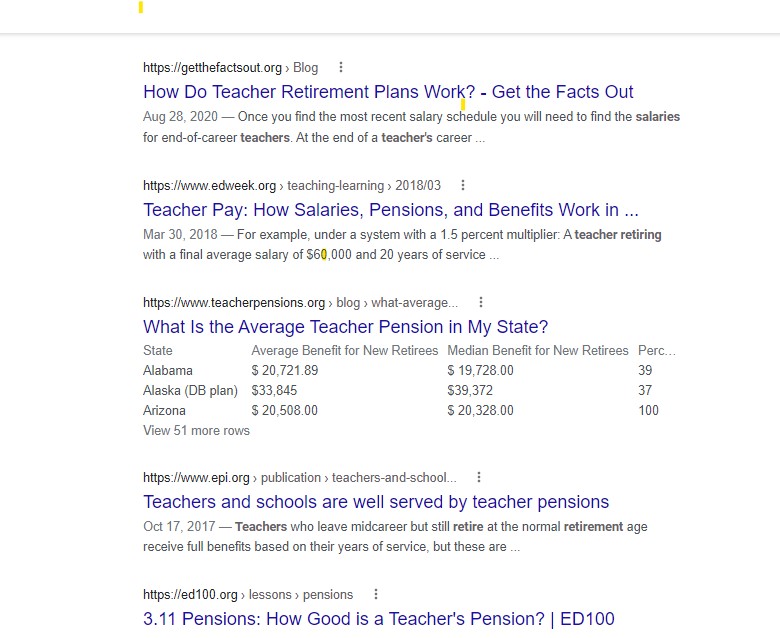
AND is one of the most common Boolean operators. Using AND can narrow a search by combining terms. For example, combining terms such as those below will result in search documents and other resources with all of the terms in the returned search items.

teacher AND pay AND retirement

Google search entered
Picture of search results – note the combination of ideas in the same documents.

OR

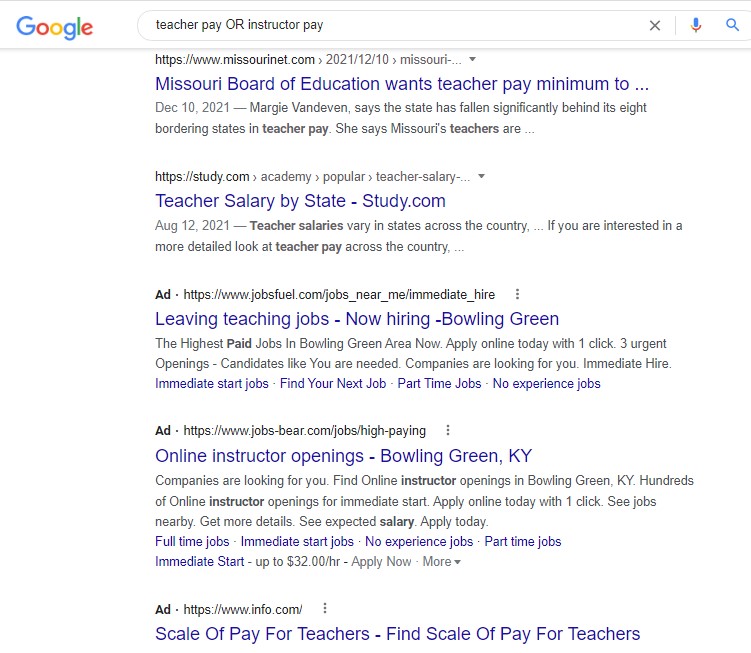
OR is a Boolean operator that broadens a search. It can be used with synonyms or with unrelated terms. For example, if the search is as shown below, the search engine will find results about teacher OR instructor pay. Simple and effective.

teacher pay OR instructor pay

Truncation

Truncation is a research technique that typically uses an asterisk. The asterisk is added to a word to search for other words that are similar but have different endings. This works especially for most databases. Please note that some databases use different symbols, so contact the library when in doubt. Most college libraries can tell you what symbol is used.

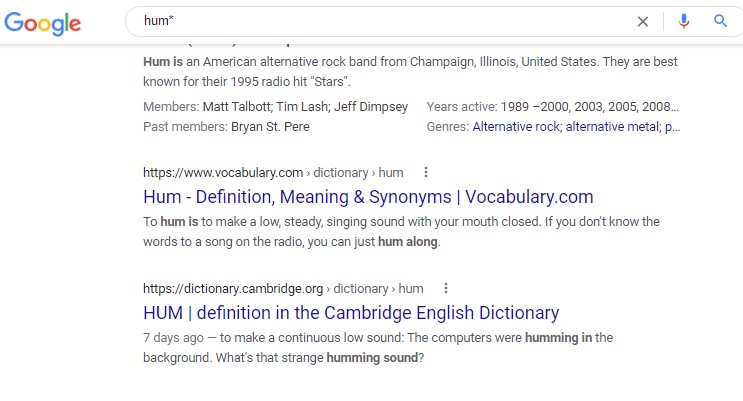
An example of using the asterisk for research is: hum* “Hum with an asterisk will tell the search engine to search for words that have “hum” in them. This my or my not work for search engines. For example, consider the search below.

Searching with an asterisk found “hum” and “humming.”

Wildcard

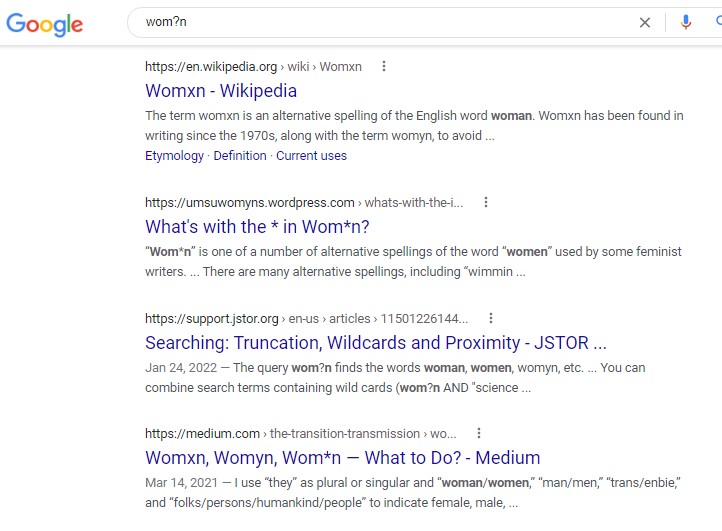
A wildcard is used to replace a letter in most database and search engine searches. Most of the time, the ? symbol can be used to replace a letter in a word to yield a wider range of words by replacing the ? with different letters in the search results. Note that # may also be used. Consider the following:

NOT

Left for last, NOT is not always the best Boolean phrase to use to do searches. While NOT doesn’t work as well with search engines, it works with most database searches. The Google search engine typically doesn’t recognize the NOT function. For example, putting in the following yields an entire list of results about Corvettes.

Cars NOT Corvettes

Because Google searches yield information about Corvettes, the screenshot was not included. In most databases using the phrase above will result in results about cars. It will exclude Corvettes.

Conclusion

Research can be a fairly lengthy process, so using simple techniques is important to reduce stress and gain helpful results. Note that using Boolean phrases can only help when a researcher uses good keywords. So, make sure you use good keywords in your searches for best results.

Summarizing, Paraphrasing, and Quoting

Learning how to summarize, paraphrase properly, and use quotes are essential skills in academic and other forms of writing. At the very least (and probably most importantly), using the skills properly can help writers avoid plagiarism. Proper use also allows students and other writers to avoid bulky writing and allows for more flexibility in writing. Lastly, my favorite reason for learning such skills is that summarizing, paraphrasing, and quoting will enable the writer to incorporate sources into writing and provide the reader with information about the original source should he/she/they want to look at it. It is a win-win.

Summarizing

Summarizing can help a writer take large chunks of information and provide an overview for the reader. This skill is handy when there is a need to break a large document down into smaller, bite-sized chunks of information. For example, if I have a 20-page peer-reviewed journal article(highly credible, by the way), I cannot hand it to the reader and say read this. The writer’s job is to break down the source inside the essay or other document where the writer incorporated the source. 

Ultimately, summarizing takes out the main points of a larger body of work. See? Simple.

Paraphrasing

If you, the writer, have not come across paraphrasing, you are in for a treat. Paraphrasing is a rewording of a passage of relatively equal length. Okay, so are we stealing? Nope.
You can easily see academic sources discuss paraphrasing, and as a researcher, I must protest how many sources teach it. It is one of the best skills to have as a research writer as it allows you (the writer) to communicate to the reader in a way that is easier to understand. Many sites will show a side-by-side view of one phrase or short section of content, and the paraphrasing is so similar that it makes me cringe! Let’s look at using an easy-to-understand paraphrase to help the reader.
The example was taken from the following article: Click here or copy/paste the link: https://dera.ioe.ac.uk/34934/1/SN06988%20%28redacted%29.pdf)

Original phrase/passage: 

“Common mental disorders (CMD) include different types of depression and anxiety, panic disorder, phobias, and obsessive-compulsive disorder. One in six people aged 16+ reported having symptoms of a common mental disorder in the week before being surveyed” (Baker, 2020, p. 4).

Paraphrased version:

In one mental-health-related survey, Baker (2020) found that high numbers of people over 16 experienced mental health symptoms a week before participating in the survey.

Comments on the example:

Here’s the thing – the above paraphrase takes the bulk out and tells the reader that those surveyed had some mental health issues leading up to the survey time. So, it maintains the original meaning minus specifics.

  • Can it be worded differently? Yes.
  • Does context (of your essay or other writing) matter? Yes. So, keep in mind that changes may be needed based on content around your paraphrase and your audience.

Quoting

Quoting is an exact copy of a sentence or sentences incorporated to add to the understanding of the essay or other writing. For the most part, quoting should be minimal, even in researched writing. I tell students in my college courses to keep quotes to around 10% of the total writing and avoid block quotes (long quotes) like the plague. I stand by that.
If you find yourself doing research and feel that you must quote, make sure that there are no other options (such as paraphrasing). Do not misunderstand. There is a place for quoting, but this copy/paste method should be strategically placed and highly relevant to the discussion.
There is one critical aspect of quoting – cite the source. For example, I pulled out a statistic from the document listed above. Here’s how it would look formatted correctly in APA based on how the author wrote the sentence/paragraph.

Quoting Example:

“Waiting times for NHS psychological therapy (IAPT) vary from 4 days to 61 days in different parts of England” (Baker, 2020, p. 3).

Easy Peasy

So, it’s easy to summarize, quote, and paraphrase. So, go forth and conquer!
For more articles on writing (now and in the future), please sign up for the newsletter, and don’t forget to subscribe to Writing Made Easy on Youtube. You can copy/paste the following link.
https://www.youtube.com/channel/UCCWW8TDREjlunOoWCLXqvnQ

What is Story?

Whether you are writing a short story, a novel, a film, or a graphic novel, readers/viewers have certain expectations. The main thing that the readers/viewers will expect is a good story equipped with stimulating images (visuals for films/descriptors for written stories), well-developed/interesting characters, action that moves the story forward to accomplish the goal/move closer to the answer to some question. For example, in Romeo & Juliet, the question that the audience wants answered is will they end up together in a happily every after? The question in The Wizard of Oz is will Dorothy make it back home to Kansas? You get the idea. Starting with a question can certainly help but is not necessarily the only way to handle a story during development. A point of caution – even though you may not begin with a question, the audience will subconsciously seek out one, so make sure in the end that you are answering the question that the reader/view has on his/her mind.

Writing a Story Question

So, the question is important, right? You bet! How does one figure out how to develop this one question?

It is based on what the central character (generally the protagonist) wants. Next, comes the question – how might the character work toward the goal/achieve the goal? If we go back to Romeo & Juliet, there are barriers in place to their love – two feuding families, Romeo kills a family member, he has to go on the run, and the list continues. Each barrier blocks their ability to be together. Hence, the question arises will they end up together in a happily every after? Once you know the character’s goal – in this case, Romeo and Juliet want to be together – then the question is easy – will they be together? It’s a fairly simple process.

Answering the Story Question

Know thy characters’ goals. The writer(s) must use the characters to move toward answering the question. To do so, there must be the ultimate goal of the character (such as getting home to Kansas in The Wizard of Oz or marrying the girl/guy in Romeo & Juliet). Before getting to the goal, the main character must have multiple obstacles in the way (such as the wicked witch – one of Dorothy’s obstacles – or killing someone and having to go on the run – one of Romeo’s obstacles).

In the end, the answer was no to whether or not Romeo and Juliet would end up together/married in a happily ever after. However, in The Wizard of Oz, the answer is yes – Dorothy makes it home to Kansas.

So, simply put, create a question and answer it before the end of the story. Make sure there are obstacles in the way (usually created by the antagonist).

Lastly, make sure the question is not announced – it is posed through the progression of the story.

Click here to red about Loglines.

Story Development – Loglines

A logline is typically a one-sentence summary that tells what your story is about. This one-sentence summary typically applies to films and television shows but can also apply to other types of stories. They offer a precision that other methods of beginning a story do not provide. For lack of a better term, the logline is the hook (attention getter) for your story. In general, loglines must be very specific and include various essential components depending on the formula used to develop the logline.

Logline template

There are several ways to construct a logline. Two of those ways are shared below, but there are other methods as well.

The Short Version

The short version of a logline is helpful but may lack the pizzazz required if you plan to market a script or story. However, it is useful and may serve as a starting point like a working thesis statement in an essay – a rough draft.

To construct a simple logline, look at it like the following:

Something happens to move the protagonist forward, who the protagonist(s) is/are, what action the protagonist is taking, and who the antagonist(s) is/are in the story.

An example of your story in a simple logline might look like the following:

When a young scientist disappears, her best friend and high school boyfriend must confront a violent gang to get her back.

The Long Version

The long version of a logline is useful and has a bit more pizzazz. It may serve as a final version of a one-sentence summary of your script or story. It’s much more like a final thesis in an essay as opposed to a rough draft. It adds in the stake(s) (what the protagonist has to lose if they don’t take action) and the protagonist’s goal in the story.

To construct the next version of the logline, look at it like the following:

Who the protagonist(s) is/are, what action the protagonist is taking, who the antagonist(s) is/are in the story, the goal that moves the protagonist(s) forward/what the protagonist will lose if no action is taken.

An example of your story in the alternate version of the logline might look like the following:

A young entomologist’s best friend and high school boyfriend must confront a local gang before their best friend is tortured and murdered.

The most crucial part of any logline is getting started. To do that, put some thought into a story that you might want to write and play with the loglines a bit. First, ask who your protagonist(s) and who your antagonist(s) are in your story. To help you, here’s a random logline generator that may or may not fit into the script above as they are linked to the industry film/television standard. So, be cautious when using a logline from a generator. With that said, generators can help with a starting point if you are having trouble generating ideas.

Chicago Style

When using the Chicago Manual of Style (CMOS a.k.a. CMS), note that it is typically used by people writing in or publishing in the field of history. While some other disciplines may use the writing style, APA is the primary formatting style for most disciplines (MLA is also used). Always check with your instructor before starting any paper.

Since CMS is used to publish, different publications have different requirements. In the realm of college, CMS is done according to your instructor’s preferences. It is fluid in a way. The template below is one that you can use and change according to instructor preferences.

Click to download a usable template to help you format your paper.

Cause – Effect Essay (One Cause + Multiple Effects)

What is a Cause-and-Effect Essay?

So, your teacher has asked you to write something called a cause and effect essay? What do you do now? First, understand what it is. This type of essay helps students understand how to logically incorporate sources (if they are required to be used). It generally revolves around some event, problem/issue, or decision/action taken that contributes to (a cause/causes) a problem and/or impacts (effect/effects(s)) someone or something (usually causing a problem/problems). So, something causes something? Exactly. So, it generally:

  • helps determine how things (phenomena) are related to each other.
  • has a thesis that states what the main cause or causes are, what the main effect or effects are according to research.
  • It has strong evidence that supports the connections between the cause(s) and event(s).

There are many ways that students can write a cause-and-effect essay. However, this article covers one way that the essay can be written: One Cause + Multiple Effects. Please click the other types to read about them.

Objectives of Article

  1. Students will learn how the cause-and-effect essay is structured, specifically for one cause-multiple effects.
  2. Students will learn the purpose of the overall cause-and-effect essay.
  3. Students will be able to construct an outline for a cause-and-effect essay.

This article helps you arrange your thoughts so that it’s not a problem when you sit down to write. Instead, you can sail through it logically. Remember: always make sure that you understand what your instructor wants before beginning any writing project. Don’t forget to brainstorm for topics before beginning an essay.

One Cause with Multiple Effects

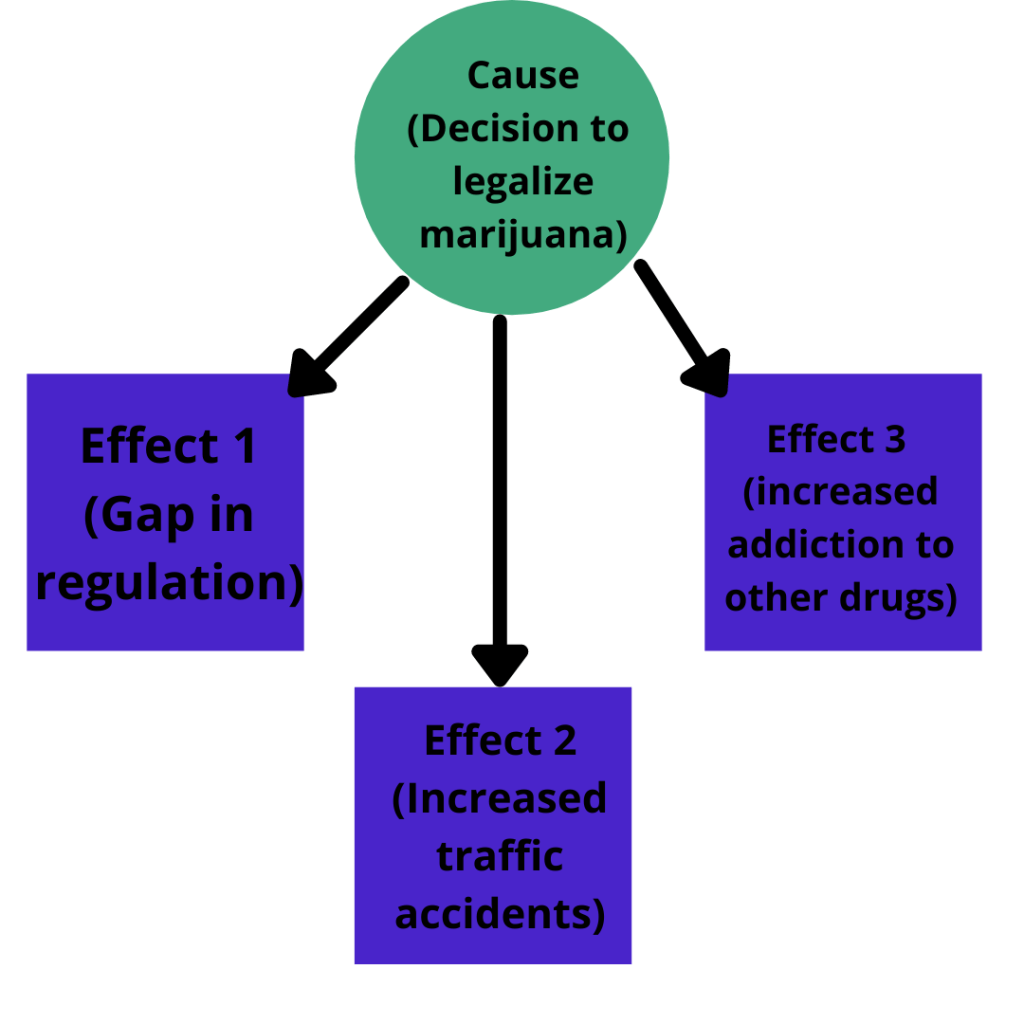
The outline for an essay where one cause contributes to multiple effects is below. Keep in mind that there may be more than three effects:

  • Introduction
    • Introduce the cause in the form of introducing the background and what contributed to the cause. For example, there may have been a movement of medical personnel to legalize medicinal marijuana to use for cancer patients and general pain.
    • Write a thesis for your essay. One example might be:
      • (informational thesis) Medicinal marijuana has contributed to unforeseen problems, including gaps in the regulation of medical marijuana, an increase in traffic accidents related to marijuana use, and the increase in medical marijuana may have contributed to the increase in the use of other drugs.
      • (argumentative with a counterargument) While medical marijuana has been shown to help with chronic pain and reduce cancer treatment side effects, the legalization of medical marijuana has contributed to unforeseen problems, including gaps in the regulation of medical marijuana, an increase in traffic accidents related to marijuana use, and the increase in medical marijuana may have contributed to the increase in the use of other drugs.
  • Body
    • Introduce Effect 1 with a source or two incorporated. For example, the first paragraph may begin like:
      • Citizens have sought out the legalization of marijuana for medicinal purposes in many states for many years.  Unfortunately, the swift passing of legislation sweeping across the U.S. has left a gap in regulation. Colorado is one such state. According to the governor of Colorado, “regulations cannot keep up with the increased number of producers of the crop” (Moore 2). Regulation is a critical element of successfully using marijuana as a medication to help patients. Incorporating more sources in the form of paraphrasing and explaining more about this effect will help students create an outstanding paper.
    • Introduce Effect 2 with a source or two incorporated (depends on the overall length of your paper). For example, the first paragraph may begin like:
      • Colorado and other states have experienced a significant increase in traffic accidents where drivers have tested positive for marijuana. Despite its legalization, marijuana may still contribute to driver impairment. According to one report, the increase in accidents where marijuana was used has increased 25% over the past two years (Baker 7). Compared to other substances involved in accidents, there may be a positive correlation between the legalization of marijuana and the increase in accidents that are related to marijuana. Incorporating more sources in the form of paraphrasing and explaining more about this effect will help students create an outstanding paper.
    • Introduce Effect 3 with a source or two incorporated (depends on the overall length of your paper). For example, the first paragraph may begin like:
      • There has been an overall marked increase in drug use and drug abuse since 2019, and the numbers continue to grow as more states legalize marijuana. Some might claim that there is no relationship between the growth and legalization, but according to Bell, “…it is no accident that illegal drug use and abuse are on the rise as marijuana use grows. After all, it has long been dubbed the gateway drug” (9). Incorporating more sources in the form of paraphrasing and explaining more about this effect will help students create an outstanding paper.
    • Counter – the counter is the opposing viewpoint. It is not always included and is generally reserved for argumentative papers. Here’s an example:
      • There is indeed evidence to support positive benefits to patients who experience pain or side effects of certain treatments for Cancer (Moore 1). However, the benefits do not outweigh the negative aspects of marijuana use. Generally speaking, this section will be a paragraph or so in an argumentative paper. If you are doing an informational essay, leave the counter out unless otherwise required by your instructor.
  • Conclusion
    • Wrap it up. While you may add more points (that is up to you), and each section will certainly have more than one paragraph, especially at the college level, now it’s time to wrap it up. Teachers may require different things, so – again – please consult your instructor. However, here are the general guidelines.
      • Tell the readers what you just told them – in other words, sum it all up.
      • Summing it up should include the most important information. This is usually done in the form of rewording your thesis.
      • Give a “so what” statement. In other words, why is the topic important to discuss.
      • Conclude your paragraph with specific steps to address the issue and call people to take action.
    • Example (informational with a dash of argument, and that’s okay): Medicinal marijuana has been and will likely continue to be legalized in many states across the U.S. While there are some potential benefits, the cost to individuals and society may be too high. Until the country can devise appropriate oversight and strict regulations, there may continue to be gaps that contribute to illegal distribution and loss of tax money to local, state, and federal governments. The relationship between the increase in drug use and abuse needs to be the topic of additional studies to determine what other factors may be contributing to the rise in numbers, if there are any. Lastly, blood test results from accident data in states where marijuana is legal certainly raises an eyebrow and may need additional study as well. Ultimately, the legalization of marijuana needs to be carefully considered as there may be alternative and safer treatments available.

Copyright 2021 – Note that this is an original article that cannot be copied unless done so for a classroom exercise. If an example or quote is used from this article, please give proper credit to avoid plagiarism. The writer reserves all rights to this article, and all examples are original and provided for informational purposes only.

5 Signs of Credibility

What is Credibility?

Credibility of a source is what makes the information usable and dependable for research purposes. A credible source is one that can be trusted to serve as good information and tends to have several qualities.

Author

The author of an article or other source is important in determining credibility. When examining a printed or online source, it’s helpful to know something about the author. A few good areas to look at regarding the author(s) experience may include: author(s) background, author(s) degree, and/or experience in conducting extensive research in the subject area.

Currency

Whether or not a source is current is extremely important, especially in fields of study that require current research to be effective. A general rule of thumb is that a source be within the past seven years. However, if a student is writing about a field such as information technology or nursing (there are others), sources may need to be more current. In contrast, if a student is writing about the history of a topic, it may be that the information does not need to be current.

Writing Style

Writing style matters. When an author does not pay attention to grammar and/or spelling, it can be a bad sign. Credible sources tend to have authors who check grammar, check spelling, and write in an organized and easy-to-understand way. Additionally, the language used should be fair (lack bias). For example, saying “demonstrators” versus “protestors” makes a difference. One is more bias than the other.

Sources

Make no mistake! A website that doesn’t use sources may not be credible. Researchers should be mindful of sources being used or not used. An author should also be using credible sources. Sources may be listed at the end of an article/source or they may appear as links in online information.

Author of this article: Jackie Gibbons (College English Instructor & Writer)/Sources include the following:

Other sources are available upon request.

APA Formatting: 7th Edition Professional & Student Versions

Minor changes in APA have resulted in two different versions for the 7th edition – Professional & Student.

Depending on the writing requirement, you may be required to use the new version of APA Formatting. The American Psychological Association (APA) had updates to the formatting style in 2019 with some key differences between the new 7th and older 6th edition version. Don’t worry. Formatting isn’t too scary if you know where to find the information to help you. At the end of this article, you’ll find some sources to help you. To stay up-to-date, don’t forget to sign up for our email list.

APA Formatting Versions

In the updated APA guidelines, there are two versions of formatted papers: professional and student. Both versions have precise guidelines. For students, I would advise asking your instructor which version you are supposed to be using. It might be that the instructor does not want you to use the 7th edition as some may still be using the 6th edition.

Student Version

Click to download the student version of APA. Again, check with the instructor to see if they want you to use the 7th edition/student version.

The template referred to in the two first videos on this page is above the first video – Student Paper

Professional Version

Click to download the professional version of APA. if you are a student, check with your instructor to make sure that you are using the desired version.

Videos are forthcoming. Additional free information can be located on Purdue OWL’s website by clicking here.

If you find this information valuable, please follow the blog. More information about formatting are forthcoming.

APA Formatting: 6th Edition

Please note that the 6th edition of APA is not the most up-to-date version. To see the 7th edition templates, including the student and professional versions, please read, “APA Formatting: 7th Edition Professional & Student Versions” article.

APA 6th Edition Information and Template

The 6th edition of APA was used up until 2019 and is still used by some colleges. I have found that most high schools generally teach MLA, which is covered in “MLA Formatting: How to Format” article. The information on this page includes:

  • A helpful APA template a.k.a. usable document that you can download and adjust to fit your needs. It includes the basic formatting and should be treated as such.
  • Videos that were made for a specific class but are directly related to using the APA, 6th Edition document.
  • Encouragement to anyone who feels overwhelmed by formatting.

Watching the video after downloading the APA template may be helpful in making sure that you change the proper items and do so without moving information around. Note that the template does not include an abstract or author’s note. Consult with your instructor to see what is required. Abstract and author’s notes can be seen in the 7th edition article/videos. The link is at the top of this video.

Cover Page of APA, 6th edition
APA, 6th Edition – Page 2

Figuring out how to format may seem like a difficult task to students, so knowing where to find resources can be very important. In addition to the Education Universe Blog, I highly recommend using Purdue Owl. Click here to go to the APA, 6th edition information on Purdue Owl.

Above all, stay calm and work on papers and formatting in segments rather than taking on the entire writing project in one session. Quality comes with slowing down and taking time to verify formatting, to do proper research, and to set goals. Rather than getting discouraged, understand that knowing where to find helpful information is one of the most effective starting places.

Be encouraged as I know that you can be successful. Start early, use the proper resources, know what’s expected, and give it your best.