Mastering MLA Formatting: A Guide to Proper In-Text Citations

In academic writing, proper citation is essential to give credit to the sources you use and to avoid plagiarism. The Modern Language Association (MLA) formatting is a commonly used citation style in college-level writing, particularly in the humanities. In MLA style, in-text citations provide brief information about the source directly within the text of your paper. Here’s a guide on how to format in-text citations in MLA style, complete with examples for college-level writers.

Basic Formatting:

In MLA formatting, in-text citations typically include the author’s last name and the page number(s) from the source. This information is enclosed in parentheses and placed at the end of the sentence or within the sentence itself if the author’s name is mentioned.
Example:
• According to Smith, “…” (45).
• “…” (Jones 25).

Author’s Name in the Sentence:
If the author’s name is mentioned in the sentence, only the page number(s) need to be included in the parentheses.
Example:
• As Brown argues, “…” (72).
• Smith’s research supports this claim (33).

Multiple Authors:
When a source has two authors, include both names in the citation. For sources with three or more authors, include only the first author’s name followed by “et al.”
Example:
• (Johnson and Smith 15)
• (Brown et al. 40)
No Author:
If a source does not have an identifiable author, use the title of the work in the citation. If the title is long, shorten it in the citation.
Example:
• (“Title of the Article” 8)
• (“Shortened Title” 25)
Corporate Authors:
For sources authored by organizations or corporations, use the organization’s name as the author in the citation.
Example:
• (National Institute of Health 3)
• (World Health Organization 12)
Multiple Works by the Same Author:
If you cite multiple works by the same author, distinguish between them by including a shortened version of the title in the citation.
Example:
• (Smith, Title of Work 18)
• (Smith, Other Title 42)
Indirect Sources:
If you cite a source that was mentioned in another source (indirect or secondary source), include the original author’s name and the phrase “qtd. in” (quoted in) followed by the name of the actual source.
Example:
• (qtd. in Smith 30)
No Page Numbers:
If a source does not have page numbers (e.g., webpages), omit the page number from the citation.
Example:
• (Brown)
• (Smith par. 5)

By following these guidelines, college-level writers can ensure their in-text citations are properly formatted according to MLA style. Remember to consult the MLA Handbook or Purdue OWL for more detailed information and examples on MLA formatting. Proper citation not only enhances the credibility of your writing but also demonstrates your respect for intellectual property and academic integrity.
Tips for Writing a College Argument-Solution Paper

Now that you’ve been tasked with writing an argument-solution paper, what are you going to do? After all, this type of paper is unlike anything you’ve written in high school or even college. Fortunately, we’re here to help you tackle the writing assignment by breaking down the components into small tasks and explaining how to write each section effectively. Follow these 7 tips for writing a college argument solution paper and get back to living your life in no time!

Introduction

The introduction to any problem (argument) and solution essay should have all the bells and whistles of a normal argumentative essay including the hook, reason for discussion, definitions that might be needed for the reader to understand the essay, and the thesis statement. What is different about an argument solution paper is its addition of a solution/several potential solutions. The essay must include an explanation of how the issue can be solved in order to provide readers with something practical they can do with their skills or knowledge after reading it. The introduction will reflect the problem/argument as well as the solution, so this type of introduction may be slightly longer than the average essay.

Body Paragraphs

Body paragraphs should reflect each point in your thesis as well as your solution section of the essay. Your first section of your essay should discuss your first point of your thesis statement equipped with any information needed to understand the point as well as supporting research. Each section of the body should represent one aspect of the thesis in the order the points were placed in the thesis. The counter point can be before or after the discussion points depending on student/teacher preferences. Make sure that the counterargument/concession has some evidence to support it as well. 

The first part of the argument-solution essay will focus on the argument (in this case – establishing that the problem exists). The second part of the body paragraphs (usually a shorter section) will focus on an overall solution or multiple solutions depending on how the paper is constructed. Note that solutions typically have some research to support them. However, your instructor may ask you to critically examine a problem and argue for a change that you create to address the problem. 

Essentially, the paper establishes there’s a problem using supporting facts or examples that illustrate why this is a problem. Then, the paper ends with how the problem can be solved/addressed. The body may (and probably will) provide information on what potentially caused this problem, such as possible barriers to resolving it; any statistics or studies that prove that there is a need to address it; and your proposed solutions. 

Lastly, this type of essay usually ends with a short analysis of how these solutions might work together or whether they are viable enough to solve the issue.

Conclusion

If you take your time to really think about the argumentative essay and do your research, writing an argumentative paper can be an exciting and rewarding process. The guidelines in this post are designed to help you with the argument and solution-writing process, but they’re not meant to restrict your creativity. With some planning and preparation, you should be able to write a successful college argument-solution paper that will make a compelling case for whatever it is you’re arguing.

Thinking About Solutions

Solution writing is much like argumentative writing. The purpose of an argumentative essay is to persuade, whereas the purpose of solution writing is to suggest possible solutions and explore options. When you’re trying to come up with possible solutions, it’s important that you don’t focus on how right or wrong your idea may be because there are too many factors at play. Instead, try to focus on what could work and what might not work instead of feeling anxious about the outcome.

Transitions Between Paragraphs

Transitioning between paragraphs or sections of an essay is important and helps the reader understand your essay. You can use transitions such as furthermore, in addition, and therefore, to show how these ideas build on one another inside paragraphs. Try to make sure that you transition into new paragraphs with a topic sentence that tells the reader what they will find in this paragraph. Additionally, in higher level writing, the instructor will typically allow the use of level one headings inside the essay to divide sections. Breaking down longer writing pieces can help others understand the overall discussion better.

Final Advice

College essays and argumentative writing, in general, are often complicated to write and can be time-consuming to edit. To make the process easier on yourself, follow these tips:

  1. Start with an introduction paragraph that clearly states your problem/argument and the reasons behind it.
  2. Provide evidence that supports your discussion using statistics, personal anecdotes or expert opinions.
  3. Include detailed examples of the way you’ve seen this topic affect people’s lives in real life.
  4. Be willing to change the points you discuss in your paper if you can’t find sources to support them.
  5. Read the rubric before writing and after you finish to avoid having to redo anything.

Finally – Just breathe!

7 Techniques for Persuasive Writing

Introduction

Persuasive writing is one of the hardest types to master, but it’s also one of the most important types of writing in any academic or business career. Persuasive writing can help you convince someone that your point of view has merit or sway them in your direction on an issue that may be controversial within your company or industry. If you’re struggling with how to write an essay, try using these seven techniques for mastering the art of persuasive writing.

1) State your opinion

Stating your opinion or taking a position is where a writer starts with persuasive writing. It helps frame an argument and it creates direction for the reader as to what you are trying to convince them about. It’s not enough to just say that you think something, you have to state why, and present facts to support your opinion. With this in mind, let’s look at some other techniques that can help you write a strong essay

2) Give concrete evidence

In an academic paper that involves persuasion and argument, there must be evidence. A reader can only buy into your points if they are backed up by facts. For example, if you are arguing for gun control legislation, you should provide statistics about how guns contribute to violence in the United States. As a reminder, don’t forget to document the evidence you find using your formatting style such as APA or MLA.

3) Avoid absolutes

Absolute thinking will get you nowhere in academic writing. It should be avoided at all costs. For example, don’t write: The sky is always blue. Instead, write Some days, the sky is blue; other days it is gray. A more practical way of looking at this is to avoid words like “everyone,” “everything,” and “always.”

4) Offer a contrasting point of view

Acknowledging the other side is very important in persuasive writing. You don’t want your reader to be left wondering if there are any points that might weaken your argument. Offer a contrasting point of view and provide reasons why you disagree with it as well. This also helps you avoid alienating the reader/listener.

5) Consider all sides

Before trying to persuade others to see your point of view, it is best to consider all sides. You should take some time to research what others have said about the topic you are writing about and think critically about their arguments. You will find that not everyone agrees with you on everything, so make sure that you address those disagreements respectfully and give a compelling argument for why your opinion should be taken into consideration.

6) Relate your topic to something memorable

Relate your topic to something others might find to be familiar. For example, if you’re writing about how a certain restaurant doesn’t have any vegetarian options, you could mention how one time you were out with your friend who was vegan and they ended up having an allergic reaction because there was no dairy-free option. In addition, it’s also important to make sure that the reader can relate to what is being discussed as well as try not to use technical language so they don’t feel alienated.

7) Use quotes (and paraphrases) from influential sources

Using quotes and paraphrasing information from credible sources is important in supporting your argument. Remember to use a citation, or attribution, at the end of any sentence that includes a quote or paraphrase so readers know where you found this information. (Citation: Lewis, K., Four Techniques to Create an Effective Argument.)

Conclusion

Persuasive writing is a technique used in essays to convince readers that your argument is correct. So, when you are writing an essay, be sure to incorporate these 7 persuasive techniques into your essay and you will have mastered the art of persuasive writing!

Cause – Effect Essay (One Cause + Multiple Effects)

What is a Cause-and-Effect Essay?

So, your teacher has asked you to write something called a cause and effect essay? What do you do now? First, understand what it is. This type of essay helps students understand how to logically incorporate sources (if they are required to be used). It generally revolves around some event, problem/issue, or decision/action taken that contributes to (a cause/causes) a problem and/or impacts (effect/effects(s)) someone or something (usually causing a problem/problems). So, something causes something? Exactly. So, it generally:

  • helps determine how things (phenomena) are related to each other.
  • has a thesis that states what the main cause or causes are, what the main effect or effects are according to research.
  • It has strong evidence that supports the connections between the cause(s) and event(s).

There are many ways that students can write a cause-and-effect essay. However, this article covers one way that the essay can be written: One Cause + Multiple Effects. Please click the other types to read about them.

Objectives of Article

  1. Students will learn how the cause-and-effect essay is structured, specifically for one cause-multiple effects.
  2. Students will learn the purpose of the overall cause-and-effect essay.
  3. Students will be able to construct an outline for a cause-and-effect essay.

This article helps you arrange your thoughts so that it’s not a problem when you sit down to write. Instead, you can sail through it logically. Remember: always make sure that you understand what your instructor wants before beginning any writing project. Don’t forget to brainstorm for topics before beginning an essay.

One Cause with Multiple Effects

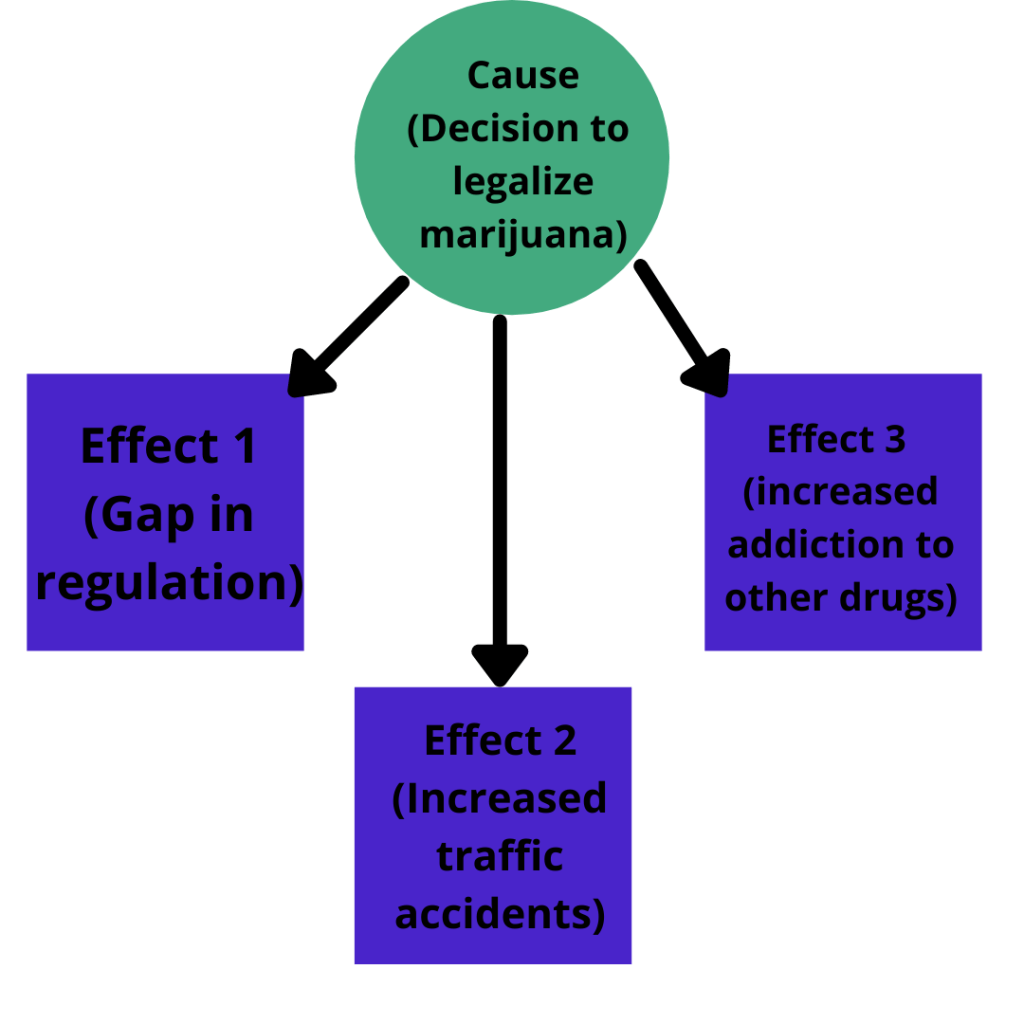
The outline for an essay where one cause contributes to multiple effects is below. Keep in mind that there may be more than three effects:

  • Introduction
    • Introduce the cause in the form of introducing the background and what contributed to the cause. For example, there may have been a movement of medical personnel to legalize medicinal marijuana to use for cancer patients and general pain.
    • Write a thesis for your essay. One example might be:
      • (informational thesis) Medicinal marijuana has contributed to unforeseen problems, including gaps in the regulation of medical marijuana, an increase in traffic accidents related to marijuana use, and the increase in medical marijuana may have contributed to the increase in the use of other drugs.
      • (argumentative with a counterargument) While medical marijuana has been shown to help with chronic pain and reduce cancer treatment side effects, the legalization of medical marijuana has contributed to unforeseen problems, including gaps in the regulation of medical marijuana, an increase in traffic accidents related to marijuana use, and the increase in medical marijuana may have contributed to the increase in the use of other drugs.
  • Body
    • Introduce Effect 1 with a source or two incorporated. For example, the first paragraph may begin like:
      • Citizens have sought out the legalization of marijuana for medicinal purposes in many states for many years.  Unfortunately, the swift passing of legislation sweeping across the U.S. has left a gap in regulation. Colorado is one such state. According to the governor of Colorado, “regulations cannot keep up with the increased number of producers of the crop” (Moore 2). Regulation is a critical element of successfully using marijuana as a medication to help patients. Incorporating more sources in the form of paraphrasing and explaining more about this effect will help students create an outstanding paper.
    • Introduce Effect 2 with a source or two incorporated (depends on the overall length of your paper). For example, the first paragraph may begin like:
      • Colorado and other states have experienced a significant increase in traffic accidents where drivers have tested positive for marijuana. Despite its legalization, marijuana may still contribute to driver impairment. According to one report, the increase in accidents where marijuana was used has increased 25% over the past two years (Baker 7). Compared to other substances involved in accidents, there may be a positive correlation between the legalization of marijuana and the increase in accidents that are related to marijuana. Incorporating more sources in the form of paraphrasing and explaining more about this effect will help students create an outstanding paper.
    • Introduce Effect 3 with a source or two incorporated (depends on the overall length of your paper). For example, the first paragraph may begin like:
      • There has been an overall marked increase in drug use and drug abuse since 2019, and the numbers continue to grow as more states legalize marijuana. Some might claim that there is no relationship between the growth and legalization, but according to Bell, “…it is no accident that illegal drug use and abuse are on the rise as marijuana use grows. After all, it has long been dubbed the gateway drug” (9). Incorporating more sources in the form of paraphrasing and explaining more about this effect will help students create an outstanding paper.
    • Counter – the counter is the opposing viewpoint. It is not always included and is generally reserved for argumentative papers. Here’s an example:
      • There is indeed evidence to support positive benefits to patients who experience pain or side effects of certain treatments for Cancer (Moore 1). However, the benefits do not outweigh the negative aspects of marijuana use. Generally speaking, this section will be a paragraph or so in an argumentative paper. If you are doing an informational essay, leave the counter out unless otherwise required by your instructor.
  • Conclusion
    • Wrap it up. While you may add more points (that is up to you), and each section will certainly have more than one paragraph, especially at the college level, now it’s time to wrap it up. Teachers may require different things, so – again – please consult your instructor. However, here are the general guidelines.
      • Tell the readers what you just told them – in other words, sum it all up.
      • Summing it up should include the most important information. This is usually done in the form of rewording your thesis.
      • Give a “so what” statement. In other words, why is the topic important to discuss.
      • Conclude your paragraph with specific steps to address the issue and call people to take action.
    • Example (informational with a dash of argument, and that’s okay): Medicinal marijuana has been and will likely continue to be legalized in many states across the U.S. While there are some potential benefits, the cost to individuals and society may be too high. Until the country can devise appropriate oversight and strict regulations, there may continue to be gaps that contribute to illegal distribution and loss of tax money to local, state, and federal governments. The relationship between the increase in drug use and abuse needs to be the topic of additional studies to determine what other factors may be contributing to the rise in numbers, if there are any. Lastly, blood test results from accident data in states where marijuana is legal certainly raises an eyebrow and may need additional study as well. Ultimately, the legalization of marijuana needs to be carefully considered as there may be alternative and safer treatments available.

Copyright 2021 – Note that this is an original article that cannot be copied unless done so for a classroom exercise. If an example or quote is used from this article, please give proper credit to avoid plagiarism. The writer reserves all rights to this article, and all examples are original and provided for informational purposes only.