Using Boolean Phrases & Other Simple Search Techniques for Research

Boolean operators can help students, faculty, and other people conduct research with a bit more ease. Using Boolean operators coupled with using synonyms for your search terms can reduce stress and ensure that you are getting the maximum benefit from your research time.

AND

AND is one of the most common Boolean operators. Using AND can narrow a search by combining terms. For example, combining terms such as those below will result in search documents and other resources with all of the terms in the returned search items.

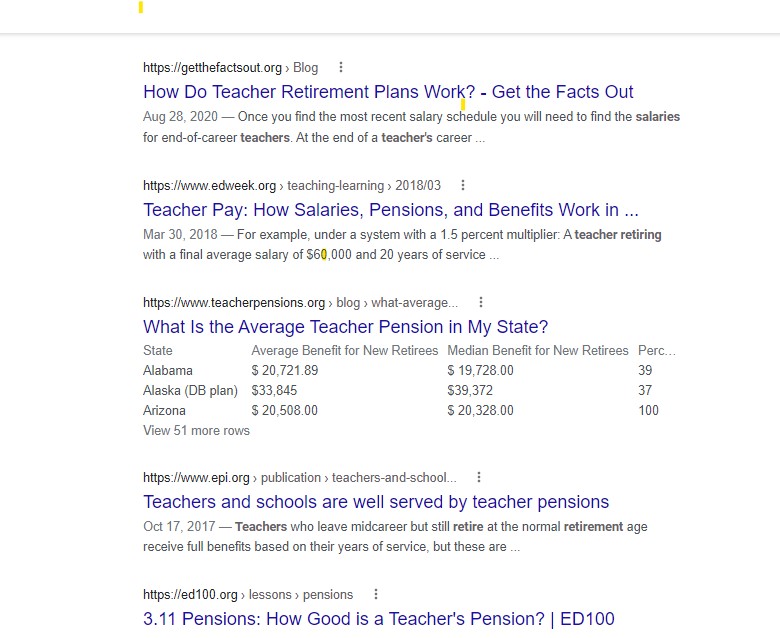
teacher AND pay AND retirement

Google search entered
Picture of search results – note the combination of ideas in the same documents.

OR

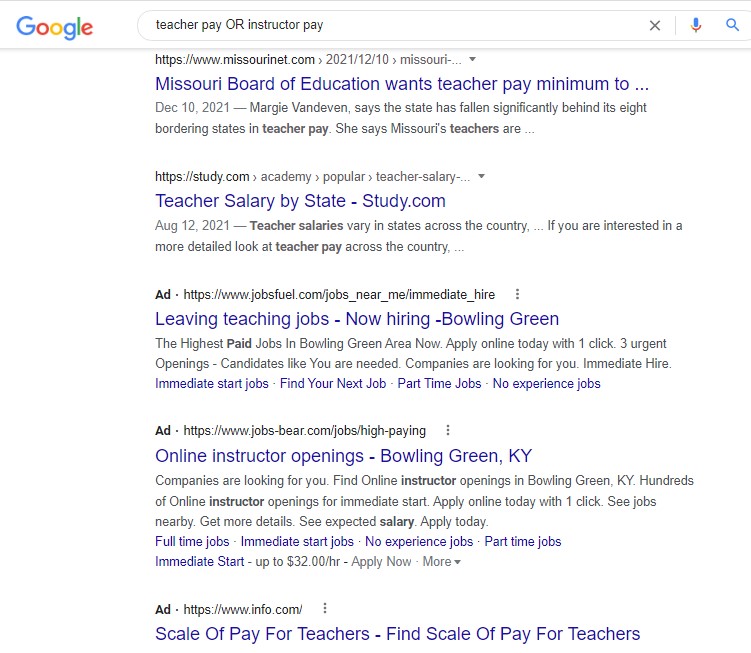
OR is a Boolean operator that broadens a search. It can be used with synonyms or with unrelated terms. For example, if the search is as shown below, the search engine will find results about teacher OR instructor pay. Simple and effective.

teacher pay OR instructor pay
Truncation

Truncation is a research technique that typically uses an asterisk. The asterisk is added to a word to search for other words that are similar but have different endings. This works especially for most databases. Please note that some databases use different symbols, so contact the library when in doubt. Most college libraries can tell you what symbol is used.

An example of using the asterisk for research is: hum* “Hum with an asterisk will tell the search engine to search for words that have “hum” in them. This my or my not work for search engines. For example, consider the search below.
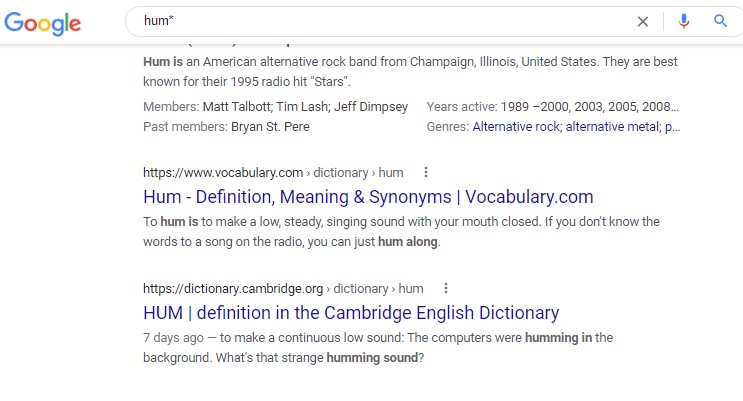
Searching with an asterisk found “hum” and “humming.”

Wildcard

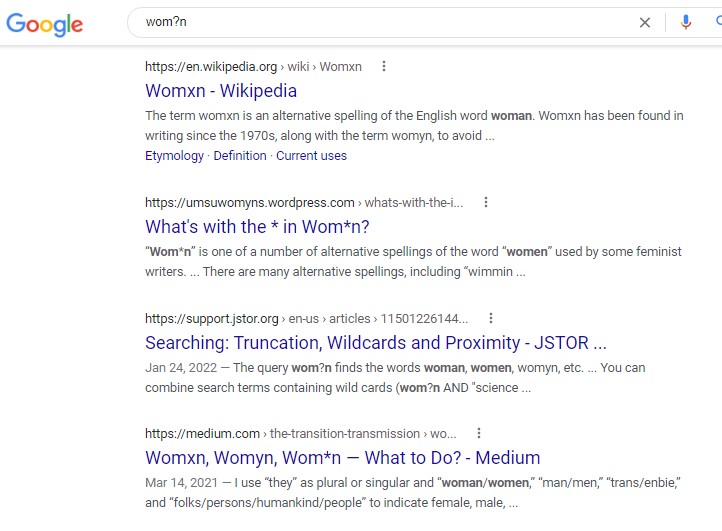
A wildcard is used to replace a letter in most database and search engine searches. Most of the time, the ? symbol can be used to replace a letter in a word to yield a wider range of words by replacing the ? with different letters in the search results. Note that # may also be used. Consider the following:
NOT

Left for last, NOT is not always the best Boolean phrase to use to do searches. While NOT doesn’t work as well with search engines, it works with most database searches. The Google search engine typically doesn’t recognize the NOT function. For example, putting in the following yields an entire list of results about Corvettes.

Cars NOT Corvettes

Because Google searches yield information about Corvettes, the screenshot was not included. In most databases using the phrase above will result in results about cars. It will exclude Corvettes.

Conclusion

Research can be a fairly lengthy process, so using simple techniques is important to reduce stress and gain helpful results. Note that using Boolean phrases can only help when a researcher uses good keywords. So, make sure you use good keywords in your searches for best results.

Summarizing, Paraphrasing, and Quoting

Learning how to summarize, paraphrase properly, and use quotes are essential skills in academic and other forms of writing. At the very least (and probably most importantly), using the skills properly can help writers avoid plagiarism. Proper use also allows students and other writers to avoid bulky writing and allows for more flexibility in writing. Lastly, my favorite reason for learning such skills is that summarizing, paraphrasing, and quoting will enable the writer to incorporate sources into writing and provide the reader with information about the original source should he/she/they want to look at it. It is a win-win.

Summarizing

Summarizing can help a writer take large chunks of information and provide an overview for the reader. This skill is handy when there is a need to break a large document down into smaller, bite-sized chunks of information. For example, if I have a 20-page peer-reviewed journal article(highly credible, by the way), I cannot hand it to the reader and say read this. The writer’s job is to break down the source inside the essay or other document where the writer incorporated the source. 

Ultimately, summarizing takes out the main points of a larger body of work. See? Simple.

Paraphrasing

If you, the writer, have not come across paraphrasing, you are in for a treat. Paraphrasing is a rewording of a passage of relatively equal length. Okay, so are we stealing? Nope.
You can easily see academic sources discuss paraphrasing, and as a researcher, I must protest how many sources teach it. It is one of the best skills to have as a research writer as it allows you (the writer) to communicate to the reader in a way that is easier to understand. Many sites will show a side-by-side view of one phrase or short section of content, and the paraphrasing is so similar that it makes me cringe! Let’s look at using an easy-to-understand paraphrase to help the reader.
The example was taken from the following article: Click here or copy/paste the link: https://dera.ioe.ac.uk/34934/1/SN06988%20%28redacted%29.pdf)

Original phrase/passage: 

“Common mental disorders (CMD) include different types of depression and anxiety, panic disorder, phobias, and obsessive-compulsive disorder. One in six people aged 16+ reported having symptoms of a common mental disorder in the week before being surveyed” (Baker, 2020, p. 4).

Paraphrased version:

In one mental-health-related survey, Baker (2020) found that high numbers of people over 16 experienced mental health symptoms a week before participating in the survey.

Comments on the example:

Here’s the thing – the above paraphrase takes the bulk out and tells the reader that those surveyed had some mental health issues leading up to the survey time. So, it maintains the original meaning minus specifics.

  • Can it be worded differently? Yes.
  • Does context (of your essay or other writing) matter? Yes. So, keep in mind that changes may be needed based on content around your paraphrase and your audience.

Quoting

Quoting is an exact copy of a sentence or sentences incorporated to add to the understanding of the essay or other writing. For the most part, quoting should be minimal, even in researched writing. I tell students in my college courses to keep quotes to around 10% of the total writing and avoid block quotes (long quotes) like the plague. I stand by that.
If you find yourself doing research and feel that you must quote, make sure that there are no other options (such as paraphrasing). Do not misunderstand. There is a place for quoting, but this copy/paste method should be strategically placed and highly relevant to the discussion.
There is one critical aspect of quoting – cite the source. For example, I pulled out a statistic from the document listed above. Here’s how it would look formatted correctly in APA based on how the author wrote the sentence/paragraph.

Quoting Example:

“Waiting times for NHS psychological therapy (IAPT) vary from 4 days to 61 days in different parts of England” (Baker, 2020, p. 3).

Easy Peasy

So, it’s easy to summarize, quote, and paraphrase. So, go forth and conquer!
For more articles on writing (now and in the future), please sign up for the newsletter, and don’t forget to subscribe to Writing Made Easy on Youtube. You can copy/paste the following link.
https://www.youtube.com/channel/UCCWW8TDREjlunOoWCLXqvnQ

What is Story?

Whether you are writing a short story, a novel, a film, or a graphic novel, readers/viewers have certain expectations. The main thing that the readers/viewers will expect is a good story equipped with stimulating images (visuals for films/descriptors for written stories), well-developed/interesting characters, action that moves the story forward to accomplish the goal/move closer to the answer to some question. For example, in Romeo & Juliet, the question that the audience wants answered is will they end up together in a happily every after? The question in The Wizard of Oz is will Dorothy make it back home to Kansas? You get the idea. Starting with a question can certainly help but is not necessarily the only way to handle a story during development. A point of caution – even though you may not begin with a question, the audience will subconsciously seek out one, so make sure in the end that you are answering the question that the reader/view has on his/her mind.

Writing a Story Question

So, the question is important, right? You bet! How does one figure out how to develop this one question?

It is based on what the central character (generally the protagonist) wants. Next, comes the question – how might the character work toward the goal/achieve the goal? If we go back to Romeo & Juliet, there are barriers in place to their love – two feuding families, Romeo kills a family member, he has to go on the run, and the list continues. Each barrier blocks their ability to be together. Hence, the question arises will they end up together in a happily every after? Once you know the character’s goal – in this case, Romeo and Juliet want to be together – then the question is easy – will they be together? It’s a fairly simple process.

Answering the Story Question

Know thy characters’ goals. The writer(s) must use the characters to move toward answering the question. To do so, there must be the ultimate goal of the character (such as getting home to Kansas in The Wizard of Oz or marrying the girl/guy in Romeo & Juliet). Before getting to the goal, the main character must have multiple obstacles in the way (such as the wicked witch – one of Dorothy’s obstacles – or killing someone and having to go on the run – one of Romeo’s obstacles).

In the end, the answer was no to whether or not Romeo and Juliet would end up together/married in a happily ever after. However, in The Wizard of Oz, the answer is yes – Dorothy makes it home to Kansas.

So, simply put, create a question and answer it before the end of the story. Make sure there are obstacles in the way (usually created by the antagonist).

Lastly, make sure the question is not announced – it is posed through the progression of the story.

Click here to red about Loglines.

5 Signs of Credibility

What is Credibility?

Credibility of a source is what makes the information usable and dependable for research purposes. A credible source is one that can be trusted to serve as good information and tends to have several qualities.

Author

The author of an article or other source is important in determining credibility. When examining a printed or online source, it’s helpful to know something about the author. A few good areas to look at regarding the author(s) experience may include: author(s) background, author(s) degree, and/or experience in conducting extensive research in the subject area.

Currency

Whether or not a source is current is extremely important, especially in fields of study that require current research to be effective. A general rule of thumb is that a source be within the past seven years. However, if a student is writing about a field such as information technology or nursing (there are others), sources may need to be more current. In contrast, if a student is writing about the history of a topic, it may be that the information does not need to be current.

Writing Style

Writing style matters. When an author does not pay attention to grammar and/or spelling, it can be a bad sign. Credible sources tend to have authors who check grammar, check spelling, and write in an organized and easy-to-understand way. Additionally, the language used should be fair (lack bias). For example, saying “demonstrators” versus “protestors” makes a difference. One is more bias than the other.

Sources

Make no mistake! A website that doesn’t use sources may not be credible. Researchers should be mindful of sources being used or not used. An author should also be using credible sources. Sources may be listed at the end of an article/source or they may appear as links in online information.

Author of this article: Jackie Gibbons (College English Instructor & Writer)/Sources include the following:

Other sources are available upon request.

APA Formatting: 6th Edition

Please note that the 6th edition of APA is not the most up-to-date version. To see the 7th edition templates, including the student and professional versions, please read, “APA Formatting: 7th Edition Professional & Student Versions” article.

APA 6th Edition Information and Template

The 6th edition of APA was used up until 2019 and is still used by some colleges. I have found that most high schools generally teach MLA, which is covered in “MLA Formatting: How to Format” article. The information on this page includes:

  • A helpful APA template a.k.a. usable document that you can download and adjust to fit your needs. It includes the basic formatting and should be treated as such.
  • Videos that were made for a specific class but are directly related to using the APA, 6th Edition document.
  • Encouragement to anyone who feels overwhelmed by formatting.

Watching the video after downloading the APA template may be helpful in making sure that you change the proper items and do so without moving information around. Note that the template does not include an abstract or author’s note. Consult with your instructor to see what is required. Abstract and author’s notes can be seen in the 7th edition article/videos. The link is at the top of this video.

Cover Page of APA, 6th edition
APA, 6th Edition – Page 2

Figuring out how to format may seem like a difficult task to students, so knowing where to find resources can be very important. In addition to the Education Universe Blog, I highly recommend using Purdue Owl. Click here to go to the APA, 6th edition information on Purdue Owl.

Above all, stay calm and work on papers and formatting in segments rather than taking on the entire writing project in one session. Quality comes with slowing down and taking time to verify formatting, to do proper research, and to set goals. Rather than getting discouraged, understand that knowing where to find helpful information is one of the most effective starting places.

Be encouraged as I know that you can be successful. Start early, use the proper resources, know what’s expected, and give it your best.